
In-use stability studies. Tested the way sites dose.
We simulate how clinical sites prepare, dilute, hold, and infuse or inject your drug product, then measure what changes.


In-use work, in numbers
- We run in-use work from formulation selection through first-in-human and marketing application.
in-use study designs since 2015
short- and long-term stability studies
from scope alignment to project start
Stability data describes the vial. Your patients receive the dose.
Once the container is opened, the drug product meets new surfaces, new diluents, and new time limits. Withdrawal, dilution, holding, and delivery through syringes, needles, lines, filters, and pumps can each change the product. Adsorption, particle formation, and degradation can follow, and shelf-life studies on the closed vial are not designed to capture them.
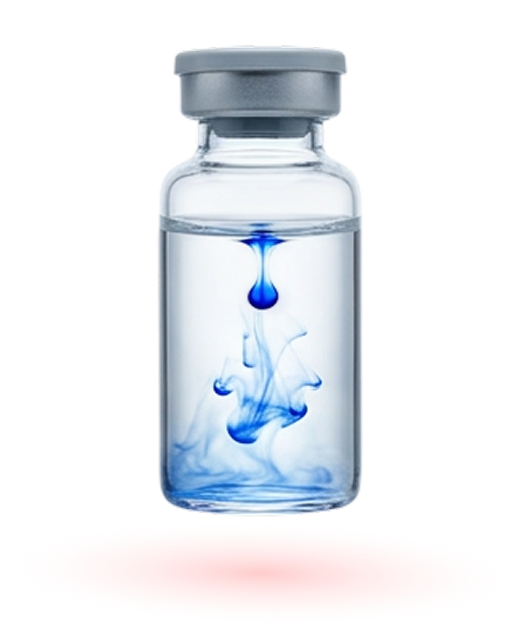
The site setup, rebuilt
We rebuild the administration path your sites will use: syringes and needles, closed-system transfer devices, IV bags, lines, extension lines, in-line filters, and catheters, delivered by gravity, syringe pump, or manual injection under worst-case handling.
What we measure
Along the path we measure recovery, adsorption, sub-visible particles, degradation products, pH, and viscosity. Color, clarity, and visible particles are assessed to pharmacopeial requirements (Ph. Eur., USP).
What we screen for:
- Adsorption loss
- Particle formation
- Diluent compatibility
- Material compatibility
- Dose accuracy
- Hold-time degradation
Which in-use study do you need?
Compatibility usually comes first, because it decides which materials and diluents the later studies use. Hold-time stability sets how long a dose can wait. Dose accuracy and recovery show whether the patient receives the intended amount. Your filing stage, dose range, and the materials your sites use decide which you need, and when.
Compatibility
Answers: Does the product tolerate each diluent and contact material?
Syringes, CSTDs, IV bags, lines, filters, and catheters
Sub-visible particles, appearance, degradation products, and pH
Particles from device components; interactions with bag or line polymers
From formulation selection, before the pharmacy manual is written
Which materials and diluents the pharmacy manual can list
Hold-time stability
Answers: How long can a prepared dose wait before administration?
Reconstituted vials, filled syringes, and diluted doses in IV bags
Degradation products, sub-visible particles, appearance, and pH over time
Time-dependent degradation and particle growth after dilution
Once the diluent and contact materials are chosen
The hold-time limit stated in site instructions
Dose accuracy & recovery
Answers: Does the patient receive the dose the protocol intends?
Full delivery path, from bag or syringe to catheter or needle
Recovery, adsorption, volume accuracy, extractable volume, and injection force
Drug loss to surfaces, most marked at low concentrations
Before first-in-human, bracketing the lowest and highest planned dose
Dosing, priming, and overfill instructions in the pharmacy manual
Three work packages, combined as needed
Each package can run on its own or as part of one study design. Compatibility results set the materials for the hold-time and dose studies, so a material that shows a problem early is replaced before more product is spent on it.
Single work packages are always possible.
Compatibility & handling
- Infusion media: 0.9% saline, 5% glucose
- Dose withdrawal by syringe or CSTD
- Vial adaptors, syringe adaptors, bag spikes
- IV bags, lines, filters, catheters
- Gravity infusion and syringe pumps
- Sub-visible particle kinetics
In-use & hold-time stability
- Hold times in bags and consumables
- Reconstituted lyophilizate stability
- Dilution studies for dose simulation
- Method suitability at low concentrations
- Red-light handling for light-sensitive products
Pre-administration & device studies
- Extractable volume, overfill, and volume accuracy
- Filtration study
- Matrix effects evaluation
- Dose formulation study
- Syringeability: drawing up and expelling
- Injectability: injection force
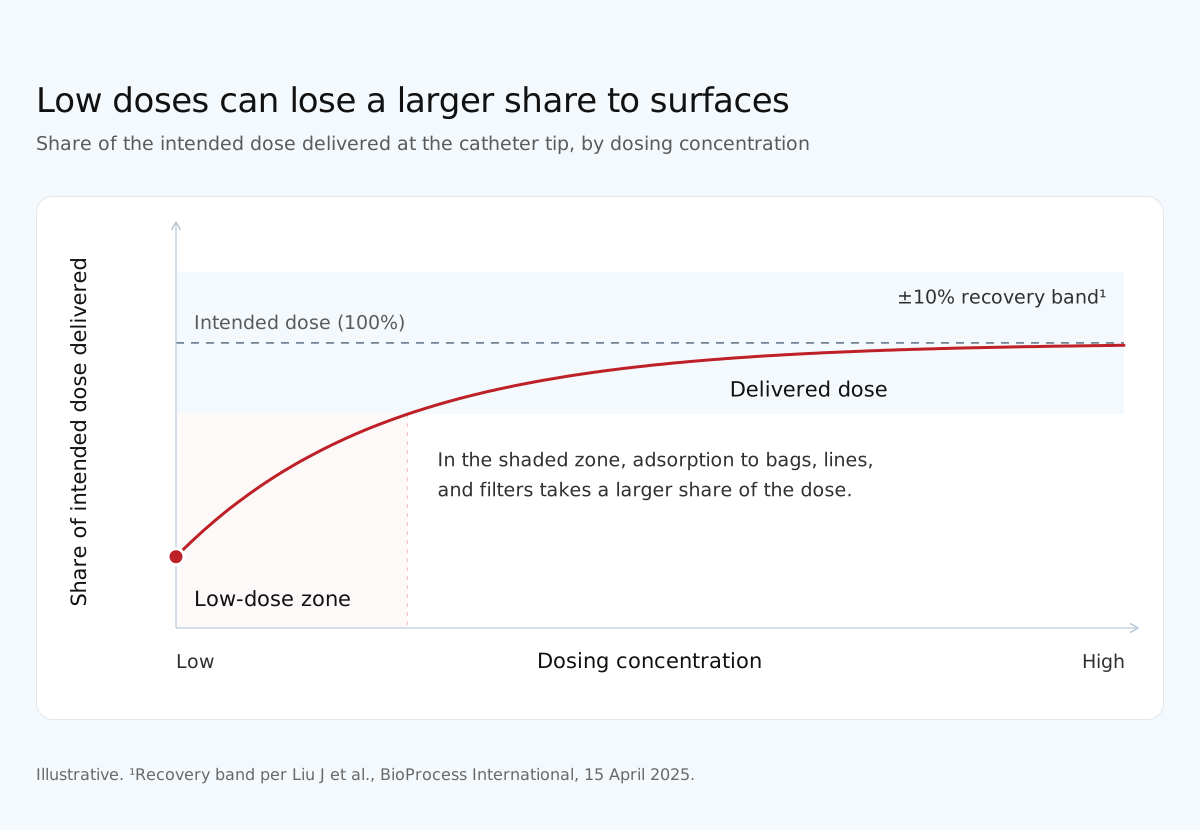
At low doses, bags and lines can take a larger share of the drug.
This matters most for low-dose arms. Adsorption binds a limited amount of drug per unit of bag, line, and filter surface.
At high concentration that loss is usually minor; after dilution to a low dose, it can become a measurable share of the intended dose. Recovery is commonly expected within ±10% of intended content.
We sample at the catheter tip, confirm the method still quantifies the diluted product, and follow particles along the same path.
Send your administration plan. We'll return a study design.
Under a CDA: your dose range and concentrations, diluents, the materials your sites will use, the hold time you need, and your filing stage. You receive a proposal that sets out the tests, their order, and the timeline.
Questions we know you have, and actually helpful answers
When should we run in-use stability studies?
As early as formulation selection. A compatibility check with your intended diluents and materials can show an incompatibility while the formulation can still change, rather than during clinical trials.
Which infusion diluents do you test?
Usually 0.9% sodium chloride and 5% glucose. For proteins, we check glucose for glycation risk, and we add other diluents when your protocol or target market requires them.
Can you source the bags, lines, and CSTDs our sites use?
Yes. We are registered with worldwide suppliers of administration consumables, so we can order small quantities of the components your clinical sites use, or work with materials you supply.
What does an in-use study for an IND or IMPD typically cover?
Typically your proposed diluent, the most relevant contact materials, worst-case handling, and at least two concentrations bracketing your lowest and highest dose, with samples taken from the delivered product.
How soon can an in-use study start?
Usually 2 to 4 weeks from scope alignment to project start. We agree on the study design, materials, and sampling plan with you before any product is used.
How is in-use stability different from shelf-life stability?
Shelf-life studies hold the closed product in storage for months. In-use studies start once the container is opened and follow the product through preparation, dilution, holding, and administration until it reaches the patient.
Do you test potency and sterility of in-use samples?
Through partner laboratories. We coordinate potency and microbiological testing externally and run the physical and chemical tests, including particles, degradation products, and recovery, in our own laboratories.
Can you run in-use studies on cytotoxic or light-sensitive products?
Yes. Cytotoxic products and ADCs are handled under containment up to OEB5 (SafeBridge category 4), and light-sensitive products are prepared and administered in our red-light laboratory.
Didn’t find your question? Conversations and quotes are always free.
Let's talk about your in-use study and how sites will dose.
Our calls veer technical fast. If we’re not the right partner, we’ll say so.