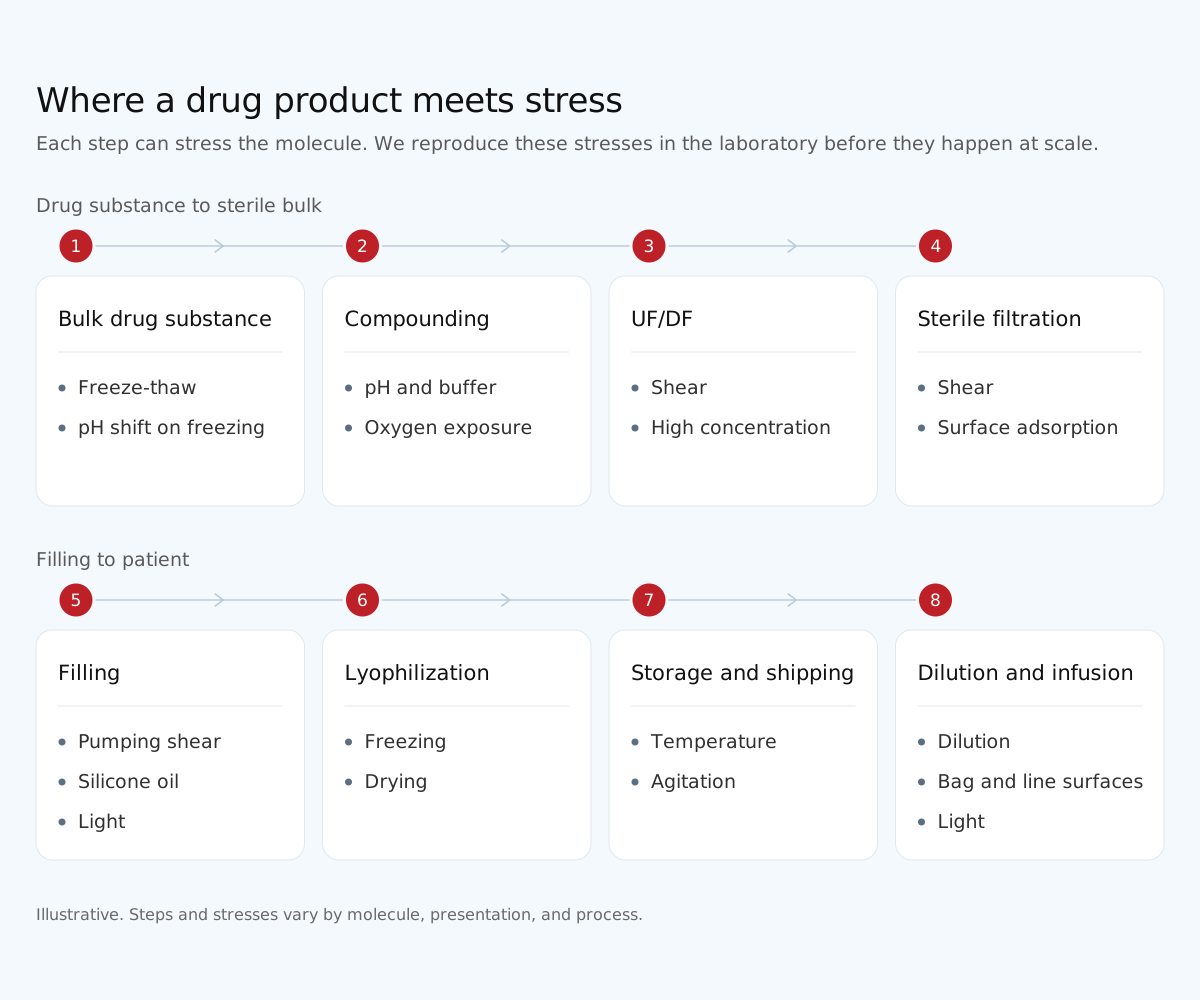
We stress your lead formulations, identify how they degrade, and use the results to choose and refine the formulation. Stress studies run as part of formulation development.
Biologics, ADCs, and viral therapeutics are stressed in physically separated laboratories.
250+
stability studies in our laboratories
Up to OEB5
containment for ADC studies
BSL-1 & 2
laboratories for biologics and viral therapeutics
2 to 4 weeks
from scope alignment to project start
Too much stress creates artifacts. Too little reveals nothing.
Biologics degrade by chemical routes such as oxidation and hydrolysis, and by physical routes, including unfolding, aggregation, and particle formation, often at the same time.
A stress that is too harsh can open pathways the product may not meet in storage, and one that is too mild can leave real liabilities undetected.
Stress designed per molecule
We choose each stress from the molecule, its formulation, and the route of administration, in line with ICH Q8 Quality-by-Design, so the pathways we find are ones your product could meet.
Same analytics for every sample
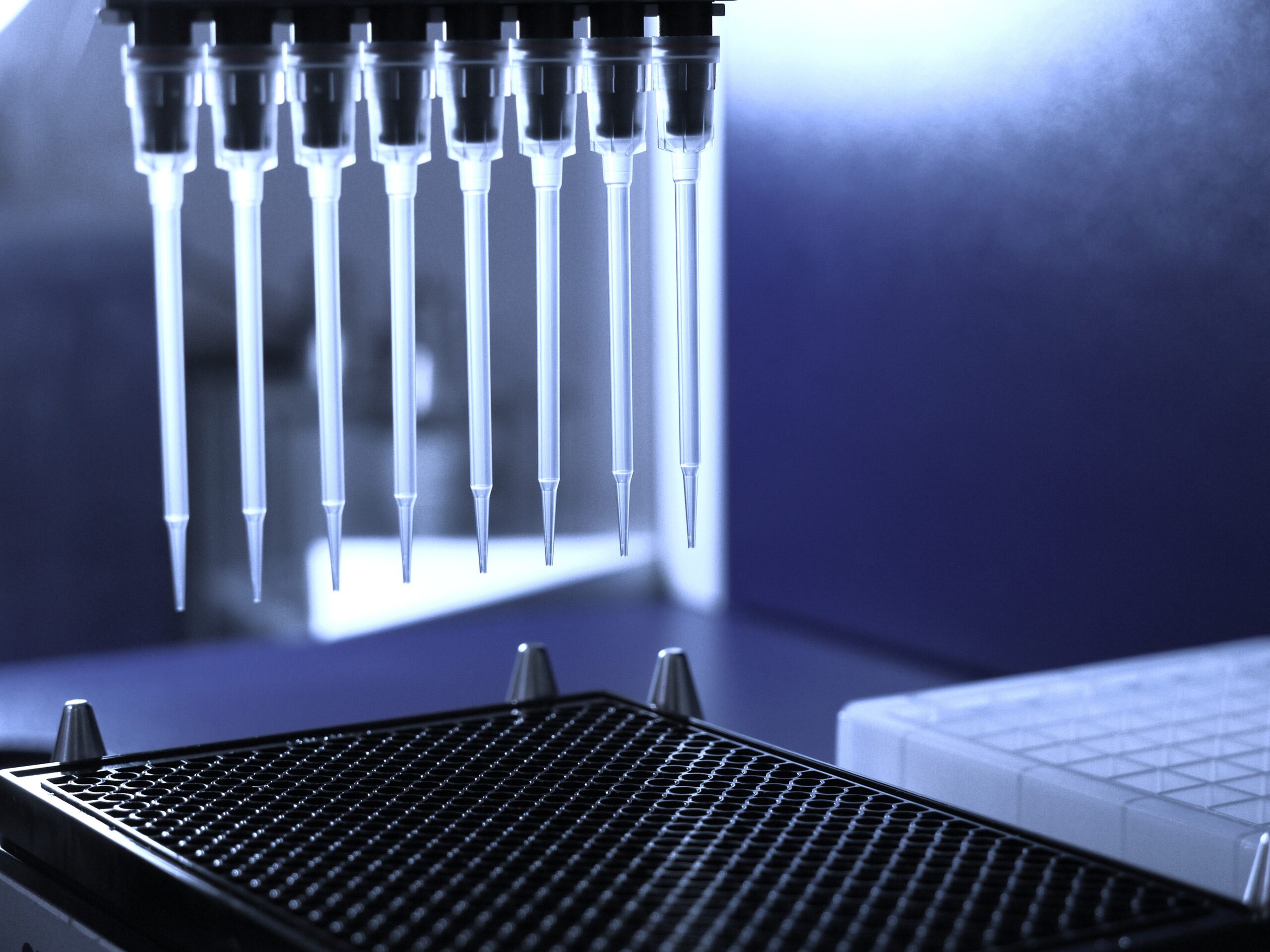
We read every stressed sample with the same method set: aggregation and fragmentation by chromatography and electrophoresis, charge variants, and sub-visible particles. Orthogonal methods available and optional.
What we screen for under stress:
Aggregation
Fragmentation
Oxidation
Particle formation
Hydrolysis
Surface adsorption
Stress, accelerated stability, or in-use?
Stress studies come first: they show how the molecule degrades and which formulation protects it. Accelerated and real-time studies then follow several lead formulations under defined storage conditions, and real-time data forms the basis of the shelf life. In-use studies cover the last step, from vial to patient. Each answers a different question.
Forced degradation & stress
Answers: How does this molecule degrade, and what protects it?
Conditions
Heat, light, oxidation, pH, freeze-thaw, agitation, and surface contact
When we run it
From candidate selection through late development, and for process changes
What it informs
Formulation, handling, and stability-indicating methods
Guideline
ICH Q5C, Q1A(R2), and Q1B, with conditions chosen case by case
Typical outcome
The main degradation routes and a shortlist of protective formulations
Accelerated & real-time stability
Answers: Which lead formulation stays most stable over time?
Conditions
Defined storage temperatures, at intended and elevated levels
When we run it
On several lead formulations, to choose the best one
What it informs
Shelf life, storage conditions, and the stability program for filing
Guideline
ICH Q5C for biologics and ICH Q1A(R2) for small molecules
Typical outcome
Stability data over time on the final formulation in its primary packaging
In-use stability
Answers: Does the product stay stable from vial to patient?
Conditions
Dilution, infusion or injection, hold times, and handling steps
When we run it
Ideally at formulation selection, before the formulation is locked
What it informs
Compatible diluents, consumables, hold times, and administration instructions
Guideline
Pharmacopeial requirements (Ph. Eur., USP) for appearance and particles
Typical outcome
Recovery, particle, and degradation data under clinical handling conditions
We run forced stress, accelerated, and in-use studies in our own laboratories.
Three stress packages, one shortlist
We agree the stress design with you before the first sample is stressed. Molecule and process stress run in parallel where material allows, and every sample goes through the same analytics.
The go/no-go point is the stress results, which show which formulations move on to stability studies.
Light and agitation show which formulation needs protection.
Agitation at air-liquid interfaces and contact with silicone oil can drive aggregation, and light can drive oxidation. We stress each lead formulation under the same conditions, so differences come from the formulation.
Highlights: in one program, a detergent and an antioxidant were both needed for the lead formulation to pass light, agitation, and freeze-thaw stress.
Forced stresses show which formulations offer protection.
Agitation at air-liquid interfaces and contact with silicone oil can drive aggregation, and light can drive oxidation. We stress each lead formulation under the same conditions, so differences come from the formulation.
Highlights: in one program, a detergent and an antioxidant were both needed for the lead formulation to pass light, agitation, and freeze-thaw stress.
Tell us about your formulations. We’ll plan the stress.
Under a CDA: your molecule type, the formulations under consideration, known liabilities, the planned route, and the material available. Stress studies run within a formulation development project.
Questions we know you have,
and actually helpful answers
What is a forced degradation study, and why run one?
It exposes a molecule to stress beyond normal storage to reveal how it degrades. The results show which quality attributes to watch and which formulation and process protect the molecule.
How is forced degradation different from accelerated stability testing?
Forced degradation uses stress beyond storage conditions to find pathways. Accelerated stability holds the lead formulations at elevated, defined conditions over time. ICH Q5C treats both as support for real-time data.
When in development should we run forced degradation studies?
During formulation development, once lead formulations exist, and again when a major process or site change calls for a comparability study. ICH Q5E notes that stress studies give a direct comparison of pre-change and post-change product.
Can you run stress studies on ADCs?
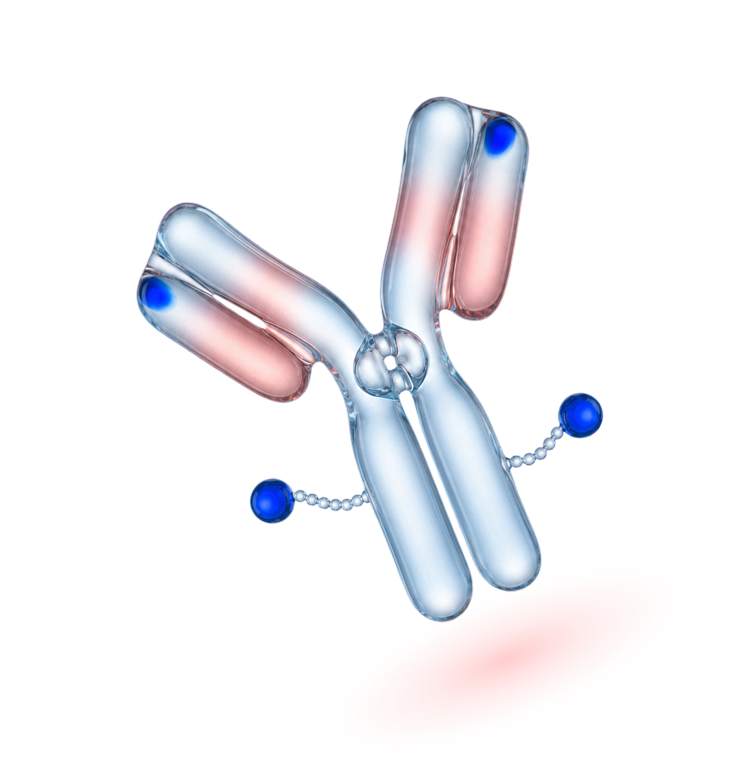
Yes. We stress ADCs and their antibody intermediates under containment up to OEB5 (SafeBridge category 4), and read aggregation, fragmentation, and charge variants on the same samples.
Which ICH guidelines apply to forced degradation of biologics?
No single guideline covers it. ICH Q5C covers stress studies for biologics, ICH Q1B covers light exposure, and ICH Q5E covers stress studies for comparability after a process change.
How much degradation do you aim for in a stress study?
Enough to reveal the main pathways without creating artifacts. We set the target per molecule and stress type, and adjust conditions after a first range-finding round.
Do you stress lyophilized products and the reconstituted solution?
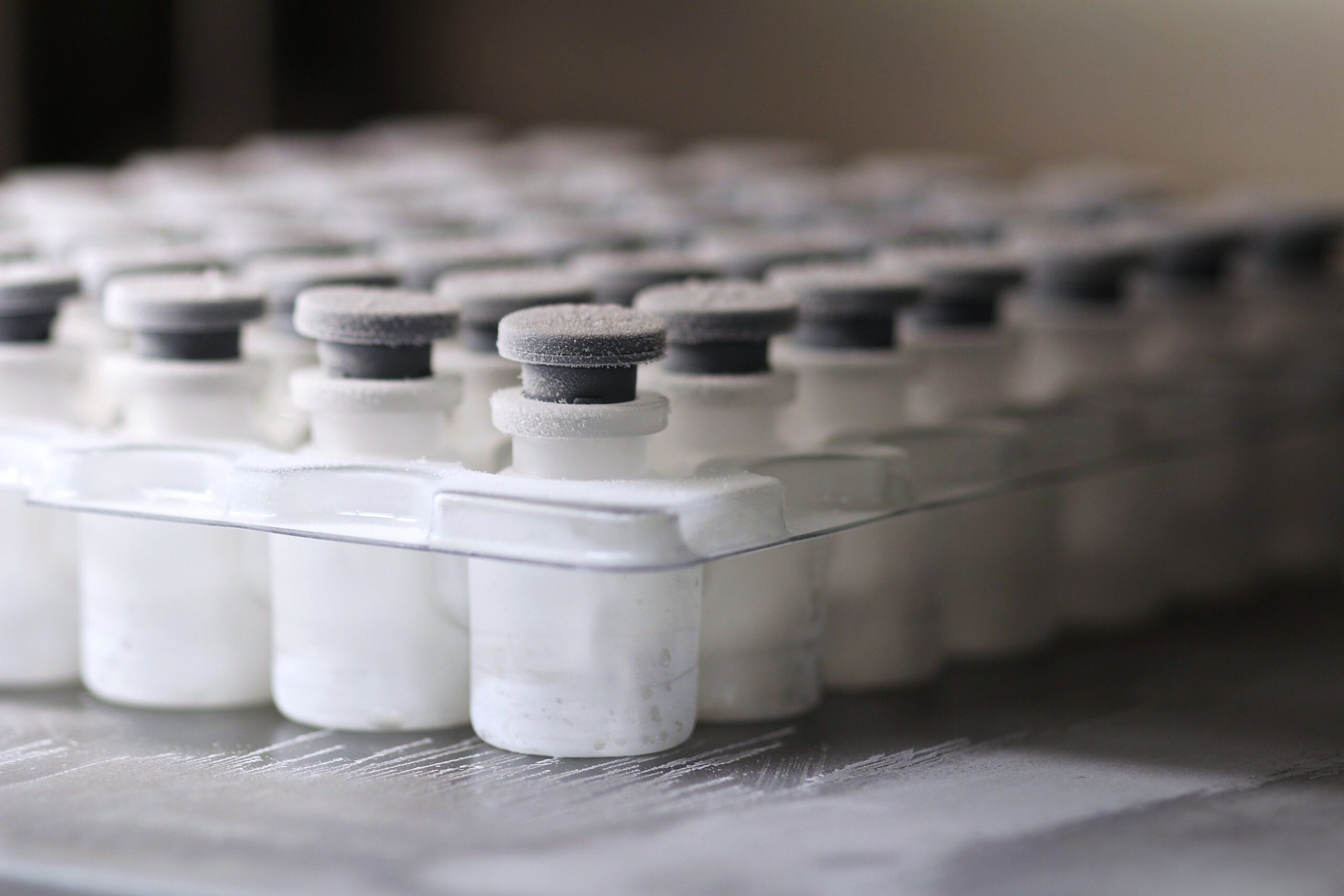
Yes. We stress the lyophilizate and the reconstituted solution, and check residual moisture and cake structure in the lyophilizate.
Can the stress study data support our regulatory filing?
Yes. We document studies under our quality system, with reports suitable for submission to authorities. Stability studies that need GMP then run at a GMP site you choose.