
We develop liquid and lyophilized formulations that keep a conjugated antibody stable, including its payload. 29 ADC programs since 2011, in cytotoxic laboratories.
We make aseptic, non-GMP preclinical batches, and the process is built to transfer to the manufacturer you choose for clinical supply.


ADC formulation and process programs
advanced to GMP and the clinic
high-concentration or subcutaneous
from scope alignment to project start
Most ADCs have lower thermodynamic and colloidal stability than their parent antibody. Attaching hydrophobic drug moieties modifies the charge pattern and strengthens hydrophobic interactions.
Reduced solubility and a pronounced tendency to aggregate can follow, particularly at higher drug-to-antibody ratios (DARs). Highly potent payloads with limited water solubility add a second challenge to the formulation.
High-throughput, predictive screening of colloidal and conformational stability identifies robust formulations quickly and addresses drug-specific stability issues, in line with ICH quality-by-design.
We combine protein formulation and process expertise with cytotoxic handling up to OEB5 and SafeBridge category 4, and characterize each conjugate’s aggregation and charge heterogeneity by chromatography.
For most ADCs entering Phase 1, lyophilized is the default, and 63% of the target product profiles in our ADC programs are lyophilizates. Frozen liquid gets to first-in-human fastest.
A refrigerated liquid is the hardest to formulate. Linker-payload hydrophobicity, DAR, and the antibody’s own stability decide which route fits.
Best for: Most ADCs entering Phase 1, especially hydrophobic payloads or higher DAR
Lowest; removing water slows linker hydrolysis and deconjugation
Moderate; the cycle is developed and run under cytotoxic containment
Simplest cold chain for a cytotoxic product
Highest per vial; containment and lyophilizer time drive it
Reconstituted under cytotoxic handling rules
Best for: Fastest first-in-human; also the usual hold for antibody intermediate and conjugated bulk
Low in storage; freeze-thaw can aggregate hydrophobic ADC species
Shortest development time of the three routes
Unbroken −20 or −70 °C chain for a cytotoxic product
Moderate; frozen storage and shipping carry it
Thawed before dosing, under cytotoxic handling rules
Best for: Late-stage or subcutaneous ADCs with a hydrophilic linker-payload
Highest; linker hydrolysis, deconjugation, and aggregation accumulate over shelf life
Longest; real-time data must show the payload stays attached
Standard 2 to 8 °C chain
Lowest per vial, if shelf life holds
Ready to use, with the fewest handling steps for a cytotoxic drug
Final ADC drug product, antibody intermediate, and linker-payload bulk have different development objectives, so each gets its own workstream within one program.
The final drug product leads, and the intermediate and linker-payload work is planned around what it needs.
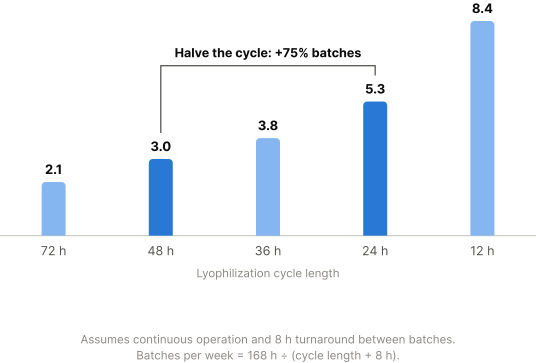
Most ADCs ship lyophilized, so cycle time sets cost per batch. Halving the cycle doesn’t double output, because loading, unloading, and cleaning are fixed, but going from 48 hours to 24 raises weekly output by about 75%.
We develop the cycle for the formulation and for your manufacturer’s freeze-dryer, map parameter effects on critical quality attributes, and test robustness across the design space.
Highlights: 60 h to 18 h, 36 h to 10 h, and 49 h to 24 h, enabling two batches per week.
Under a CDA: your sequence or molecular weight, pI, DAR range, OEB or exposure data, and target product profile. You get a proposal with what we’d test, in what order, and how long it takes. Average client satisfaction: 9 out of 10.
Yes. We make aseptic, non-GMP preclinical batches for toxicology and stability studies in our cytotoxic laboratory, then transfer the process to your manufacturer for clinical supply.
Yes. Six of our 29 ADC programs were high-concentration or subcutaneous. At high concentration, viscosity, syringeability, and injectability set the limits, so we test all three alongside stability.
Yes. Sixteen of our 29 ADC programs advanced to GMP manufacturing. Before transfer, we mock up fill and finish: filtration study, filter integrity test, filling study, and check weights.
Yes. Higher DAR and hydrophobic payloads raise aggregation risk, so our screening tracks aggregation, charge heterogeneity, and deconjugation, and we can lyophilize linker-payloads from organic solvents.
Yes, that’s the usual case. If the naked antibody is available too, a side-by-side comparison shows how much the linker-payload affects stability.
First generation through next generation: 48% of our ADC programs are third generation, 29% second, 18% first, and 5% next generation. The most frequent payloads are exatecan, auristatin, and amanitin.
Yes. In our in-use studies, 2 of 4 IV-set brands and 1 of 2 closed-system transfer device brands exceeded sub-visible particle limits, so we test what your sites use.
Usually two to four weeks from scope alignment to project start. Your proposal sets out the timeline for each workstream, from screening to stability data.
Didn’t find your question? Conversations and quotes are always free.
Our calls veer technical fast. If we’re not the right partner, we’ll say so.