
Downstream process development, built toward the final formulation.
We develop purification and UF/DF steps around your molecule’s stability, screen chromatography and membrane steps, and deliver the drug substance in a usable formulation.


Downstream support, in numbers
- Laboratory-scale studies on small protein amounts, completed before your process scales up.
to report results after testing
laboratories for proteins and viral therapeutics
from scope alignment to project start
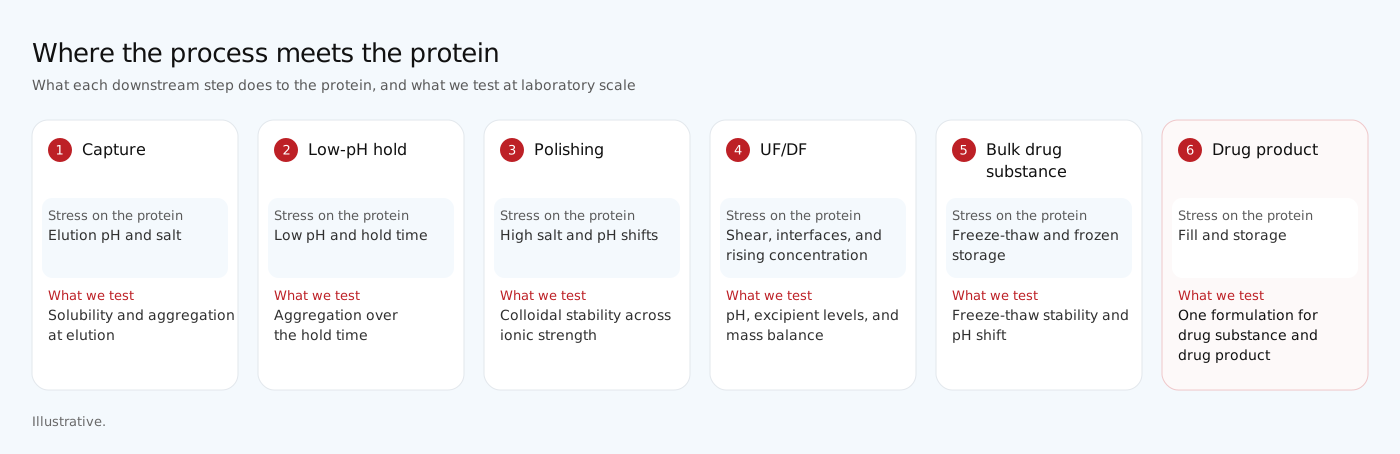
Each purification step changes the protein environment.
Elution and low-pH holds, high-salt loads, and the shear and air-liquid interfaces of tangential flow filtration each move a protein away from its most stable state.
Aggregation, precipitation, and chemical degradation can follow. The cost shows up as lower yield, fouled membranes and columns, and a drug substance buffer that may need exchanging again before fill.
Stability-guided step design
We profile how pH, ionic strength, buffer type, and stabilizers affect your molecule in a design-of-experiments matrix, then set chromatography and membrane steps from that data, following quality-by-design principles (ICH Q8 and Q11).
Formulation science inside DSP
We measure colloidal, conformational, and interface stability, aggregation, and solubility under each step’s conditions, using light scattering techniques, calorimetry, and chromatography, so stability issues surface before scale-up.
What we screen for under stress:
- Aggregation
- Precipitation
- Membrane fouling
- Column obstruction
- Yield loss
- Excipient shift
How should drug substance reach fill?
Ideally, in one formulation that suits both the drug substance (DS) and the drug product (DP), so nothing changes at fill. If purification or long holds need a different buffer, it is exchanged before fill.
Either way, it can be stored frozen in bulk. Your process conditions, hold times, and target concentration decide which route fits.

Common DS/DP formulation
Best for: Programs where purification conditions and drug product stability align
The final formulation must also suit the last purification steps
Final diafiltration delivers the DP formulation, with no re-buffering
Bulk held in the same formulation the patient receives
One composition and one specification set to transfer
A formulation change affects both drug substance and drug product
Separate DS buffer
Best for: Steps or holds needing conditions unsuited to the drug product
An extra buffer exchange at fill can add loss and stress
DS buffer set for purification; DP formulated at compounding
DS buffer chosen for hold and freeze-thaw stability
Two compositions and two specification sets to transfer
DP formulation can change without touching the DS process
Concentrated frozen bulk DS
Best for: Long storage, shipping between sites, or campaign manufacturing
Freezing can shift pH and concentrate solutes locally
Concentration, freezing, and controlled thawing added before fill
Frozen bulk extends hold time; container and freezing rate matter
Thawing and mixing steps defined for your manufacturer
One bulk can be diluted into more than one presentation
Three work packages, one hand-off
Each package can run alone or as one program. Stability profiling comes first and sets the conditions the step screening tests. UF/DF development closes the program, with a go/no-go on the common formulation before your manufacturer scales the process.
Stability under process conditions
- pH and ionic strength profiling
- Buffer and stabilizer screening
- Colloidal and conformational stability
- Hold-time stability of intermediates
- Bulk freeze-thaw, including pH shift
Step screening
- Chromatography step selection
- Membrane and column clogging
- Product loss and step yield
- Step conditions by design of experiments
- Early material for forced degradation
UF/DF & final formulation
- Membrane type selection
- Transmembrane pressure and flux
- Total mass balance
- Diafiltration into the final buffer
- Bulk pre- and sterile filtration
- Detergent and excipient quantification
The final diafiltration step decides what the drug product starts with.
Your drug substance reaches fill in whatever the last UF/DF step leaves behind. As concentration rises, the charged protein can shift pH and excipient levels away from the diafiltration buffer, so the retentate may not match the buffer you designed.
We track pH, excipient levels, and mass balance across diafiltration, and set the buffer so the drug substance arrives in the intended formulation.
Share your process steps. We'll propose the studies.
Under a CDA: your DSP flow with step conditions and hold times, the target formulation or target product profile, and known yield, clogging, or aggregation issues.
You get a proposal with the studies, their order, and timing. Average client satisfaction: 9 out of 10.
Questions we know you have, and actually helpful answers
Who runs the purification at scale, you or our manufacturer?
Your manufacturer, or your own team. We develop and screen the steps at laboratory scale and hand over the conditions, which can lower risk at transfer to GMP manufacturing.
Can drug substance and drug product share one formulation?
Yes, in many programs. We test whether the drug product formulation holds up through the final purification steps and holds, then design the last diafiltration to deliver it.
Why does my protein aggregate during purification?
Low pH, high salt, and interfaces during filtration are common causes. We measure colloidal and conformational stability under each step’s conditions to find which step drives aggregation.
Can you help when membranes or columns clog?
Yes. We screen pH, ionic strength, and buffer type for solubility and aggregation at each step, which can reduce fouling and product loss on membranes and columns.
Which molecules do you support in downstream development?
Monoclonal antibodies and bispecifics, recombinant and fusion proteins, antibody intermediates for ADCs, and viral therapeutics, with viral work in our BSL-2 laboratory.
How much protein do you need to start?
A fixed amount of purified protein or intermediate pool covers the first stability profiling. Step screening and UF/DF development need more, and we size it in the proposal.
How soon can a downstream project start?
2 to 4 weeks from scope alignment to project start. Packages can start separately, so stability profiling can begin while you prepare intermediate pools for step screening.
Can you test hold-time stability of purification intermediates?
Yes. We hold pools under your process conditions and track aggregation, degradation, and pH, which shows where the process can pause and for how long.
Didn’t find your question? Conversations and quotes are always free.
Let's talk about your downstream process and the formulation it feeds.
Our calls veer technical fast. If we’re not the right partner, we’ll say so.