
PREFORMULATION SCREENING
Know if it formulates before you nominate.
Candidates that look alike in discovery assays can behave differently in a vial. We test formulation behavior before development candidate nomination.


Early feasibility, in numbers
- Across mAbs, ADCs, and fusion proteins, from preclinical batches to lifecycle programs.
reached by all five leads in one example project
API per candidate for feasibility
above target in the concentration challenge
to a go/no-go on concentration
Discovery assays rank binding, but they don’t show behavior in a vial.
Candidates are usually ranked on potency, selectivity, and expression, measured at low concentration in research buffers. Under those conditions, weak attraction between molecules, an early unfolding temperature, or a low solubility limit rarely shows.
These liabilities appear at target concentration, in the final buffer, or on stability, often after cell line development and CMC work have already started.
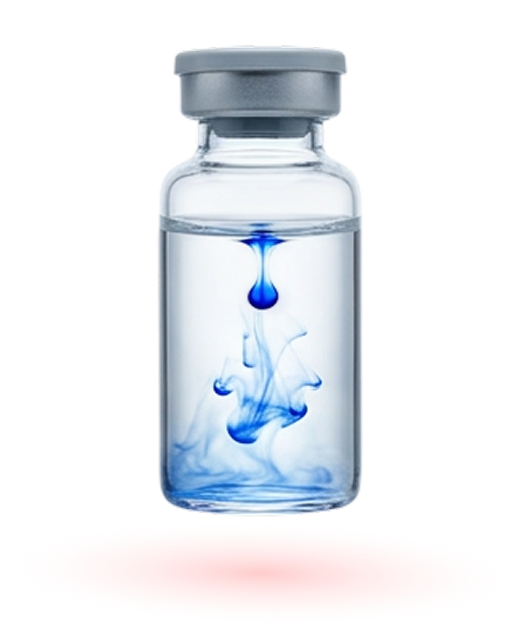
Early data only indicate
Interaction parameters measured at low concentration indicate how a molecule behaves when concentrated; they do not confirm it.
Self-association, opalescence, and viscosity can rise steeply near target, and the Donnan effect shifts pH during UF/DF.
We measure, then push further
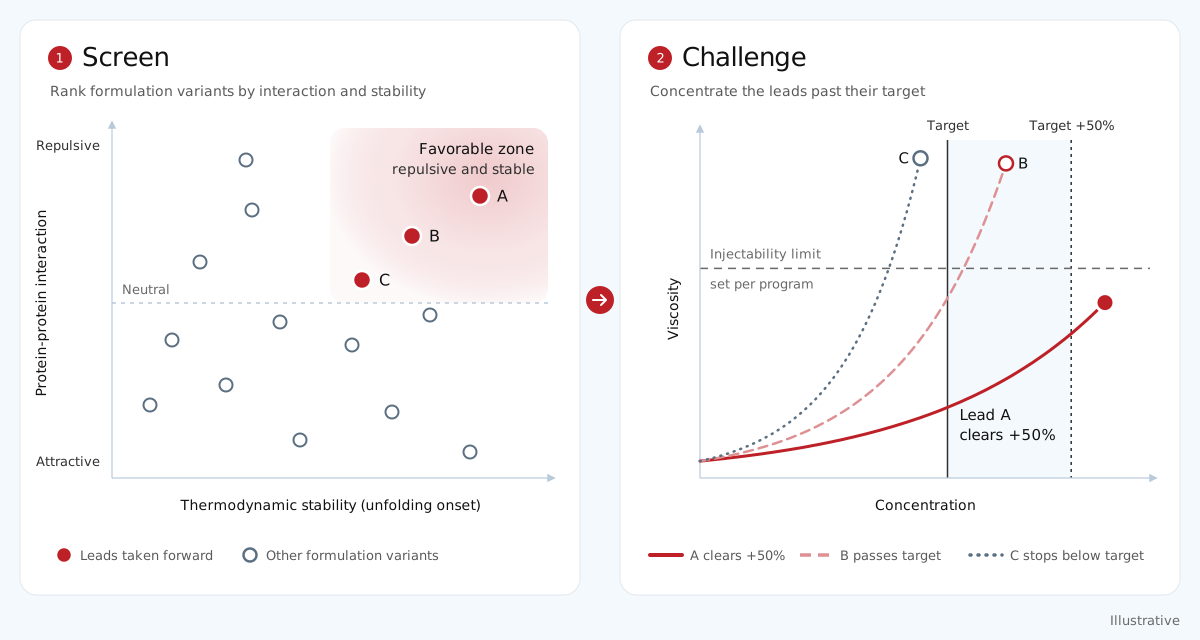
We test colloidal stability, thermodynamic stability, and aggregation across a predefined formulation panel, with optional orthogonal checks, then concentrate the lead formulation variants beyond target.
What we screen for:
- Protein-protein interactions
- Unfolding
- Aggregation
- Solubility limit
- Opalescence
- Freeze-thaw sensitivity
When should you test formulation feasibility?
Test before development candidate nomination whenever two or more candidates remain: it needs little material and can change the choice.
With one lead and a set target, the question becomes whether it reaches and holds that concentration stably. As tox and Phase 1 approach, feasibility data then feed formulation development and the first preclinical batches.
Several candidates
Main question: Which candidate behaves best in formulation?
Stability screening of each candidate across one predefined formulation panel
About 35 mg API per candidate, at 5 mg/mL or more
Ranked candidates, each with its most stable formulation
Nominating on binding data while a formulation liability stays hidden
Concentration challenge on the top candidates

One lead, target concentration set
Main question: Can the lead reach and hold its target concentration?
Concentration challenge up to 50% above target, then short-term stability
About 150 mg of API for the lead formulations
A go/no-go and the concentration ceiling for each formulation
Viscosity or solubility limits found only during Phase 1 formulation work
Formulation development, or high-concentration work for subcutaneous targets
Tox & Phase 1
Main question: Which formulation goes into tox studies and Phase 1?
Formulation development, forced degradation, and stability on the feasibility lead
Scaled to the batches your tox studies need
A defined formulation ready for aseptic, non-GMP preclinical batch production
Tox material that could differ from the clinical formulation
Technology transfer to your manufacturer for clinical supply
Three checks before candidate nomination
Each check answers one question, and each can be booked on its own. Many teams start with the screen while several candidates remain; others come with one lead and a target concentration. Results come as ratings per formulation and condition, with a ranking and recommended next steps.
Screening for stability
- Colloidal stability
- Thermodynamic stability
- Aggregation tendency
- Predefined formulation panel, plus your own variants
- Cryoprotectants included for lyophilization flexibility
Finding the concentration ceiling
- Up to 50% above target
- Viscosity at or above target
- Opalescence, turbidity, and precipitation
- pH and osmolality shifts
- Freeze-thaw assessment
Confirming the lead formulation
- Filtered samples, filled into vials
- Multiple temperature conditions
- Short-term stability timepoints
- Extended stability timepoints
- Lyophilization feasibility for liquid leads
- Explore formulation development
Repulsive protein-protein interactions suggest a formulation can go higher. Upconcentration then proves it.
The formulation chosen early carries into every later study, so the choice deserves data. Protein-protein interaction measurements show whether molecules repel or attract at low concentration, and thermodynamic stability measurements show where unfolding begins. Together, they rank formulations, so we invest only in the most promising.
Highlights: in one example project with a larger panel than usual, we screened 28 formulations, advanced 5, and all 5 exceeded 225 mg/mL.

Send us five details. We'll send back a scope.
Under a CDA: the number of candidates and their modality, pI, the material and concentration you have (5 mg/mL or more), and your target concentration, route, and presentation.
You get a fee-for-service proposal with what we test, in what order.
Questions we know you have, and actually helpful answers
What does a developability assessment cover at PJP?
Formulation behavior: colloidal and thermodynamic stability, aggregation, the concentration ceiling, and short-term stability. Sequence, expression, and immunogenicity assessments sit with your discovery partners.
How much API do you need for preformulation screening?
About 35 mg per candidate, at 5 mg/mL or more, for the screen, and about 150 mg for the concentration challenge: under 200 mg in total.
Why does a candidate that looked fine fail at high concentration?
Low-concentration data only indicate behavior. Packed closely, molecules attract through surface patches, so viscosity and opalescence rise. Our High Concentration & Subcutaneous page covers what comes next.
What do protein-protein interactions tell me about my molecule?
Whether molecules repel or attract. Repulsion points to lower aggregation risk at high concentration; attraction points to higher risk.
How long until we have a go/no-go decision?
Within four weeks of the start: about two weeks of screening, then one to two weeks of concentration challenge. Projects typically start 2 to 4 weeks after scope alignment.
Does preformulation screening replace formal formulation development and stability studies?
No. Screening ranks formulations and flags risks early. Formal formulation development and stability studies for registration, under ICH Q5C, still follow, starting from the formulations the screen selected.
Can you screen ADCs, bispecifics, and peptides?
Yes. We screen mAbs, bispecifics, ADCs, and fusion and other recombinant proteins. Peptides we assess case by case, depending on molecule size and whether the methods apply.
When should I check lyophilization feasibility?
Early, because the screen already covers it. Our panel includes cryoprotectants, so a liquid lead can be freeze-dried later without repeating the screen. A platform freeze-drying cycle confirms it on request.
Didn’t find your question? Conversations and quotes are always free.

Let's talk about your candidates and how they will behave in formulation.
Our calls get technical quickly. If another partner fits better, we’ll tell you.