
HIGH CONCENTRATION & SUBCUTANEOUS FORMULATION
High concentration & subcutaneous. From preclinical to lifecycle.
We develop high concentration formulations, and the UF/DF processes behind them, for subcutaneous delivery at every stage.


High-concentration work, in numbers
- Across mAbs, ADCs, and fusion proteins, from preclinical batches to lifecycle programs.
high-concentration or subcutaneous programs
ADC concentrated in liquid, no precipitation
achieved across multiple mAb programs
API per candidate for feasibility
from scope alignment to project start
At high concentration, the same protein has different problems.
In a highly concentrated liquid formulation (HCLF), molecules attract one another through charged and hydrophobic surface patches. Viscosity rises exponentially, and self-association, opalescence, and precipitation can appear, each of which can force reformulation.

It changes again at scale-up.
A buffer that works at 10 mg/mL can behave differently at 150 mg/mL. During UF/DF, the Donnan effect shifts pH and excipient levels as the protein concentrates, so problems also surface at scale-up.
Formulated for repulsion.
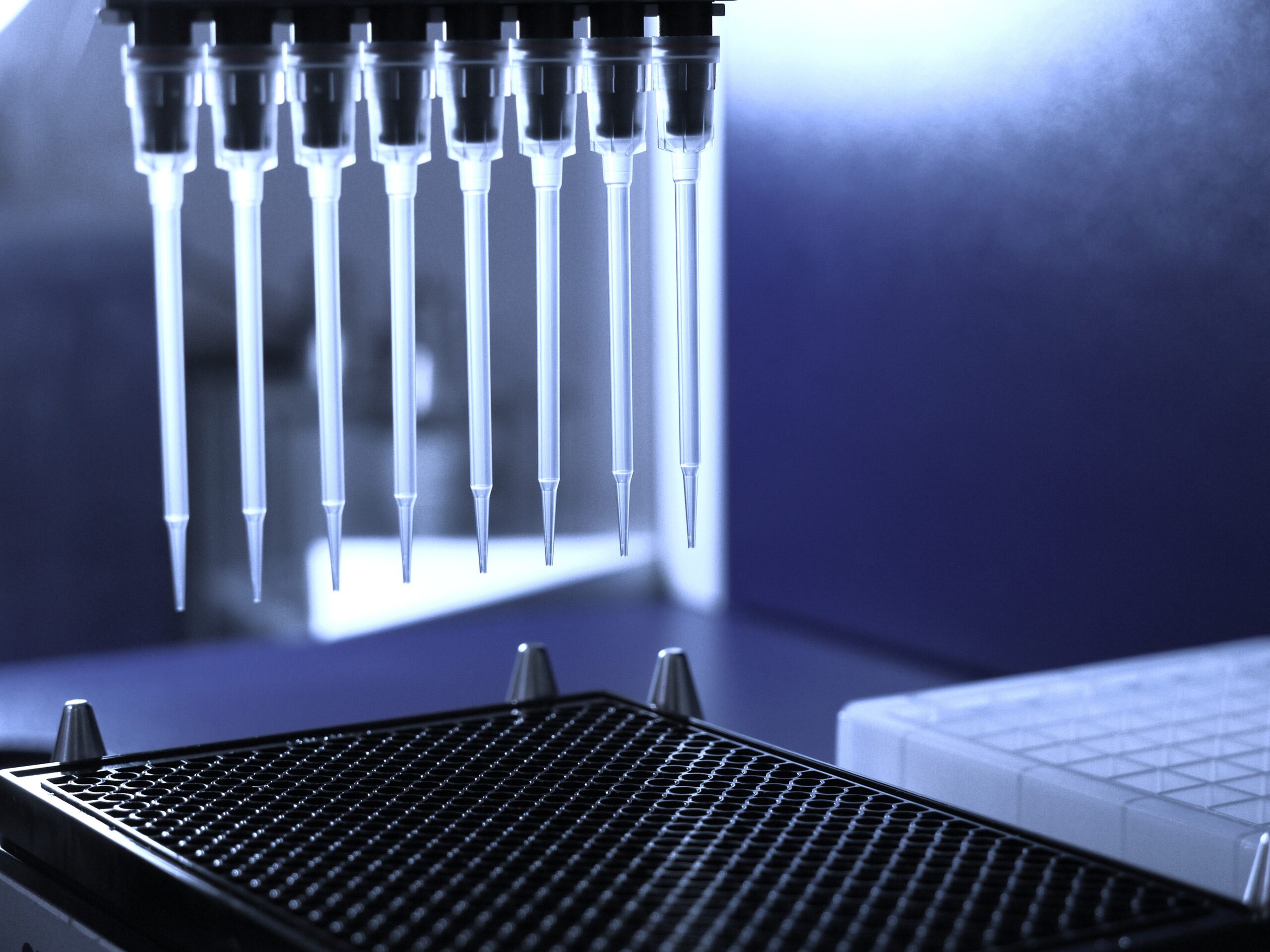
The goal is a physically and chemically stable, low-viscosity solution. We adjust pH, ionic strength, and excipients toward repulsive protein-protein interactions, then measure viscosity, turbidity, osmolality, aggregation, and particle size distribution at target.
What we screen for:
- High viscosity
- Self-association
- Opalescence
- Phase separation
- Aggregation
- Sub-visible particles
What changes at each stage?
High-concentration work changes with your program’s stage. Preclinically, the question is whether the target concentration is achievable. In clinical development, it’s whether the formulation and process hold their quality through scale-up and shelf life. At lifecycle, it’s how to move an approved product to subcutaneous self-administration.
Preclinical
Screening, concentration challenge up to 50% above target, and short-term stability
Under 200 mg API for feasibility; more for syringes and stability
Liabilities found early, before cell line and CMC commitment
As relevant, aseptic, non-GMP vials; prefilled syringes for stability studies
A data foundation for full formulation development and stability studies
Clinical development
Excipient optimization, UF/DF process development, and forced, accelerated, and in-use stability
Grams of clinical-grade material for process and stability work
pH and excipient shifts during UF/DF, and particle formation
Syringeability and injectability in-system, including injection force
Process transferred to your manufacturer for clinical supply
Late stage and lifecycle
High-concentration reformulation (lyophilizate to liquid, or vice versa) and new primary packaging
Commercial-scale material is available for development work
Comparability with the approved product, and in-syringe shelf life
Prefilled syringes, cartridges, or dual-chamber systems for self-administration
Development data to support comparability and transfer to your manufacturer
Concentration sets the dose, but syringeability and injectability decide delivery.
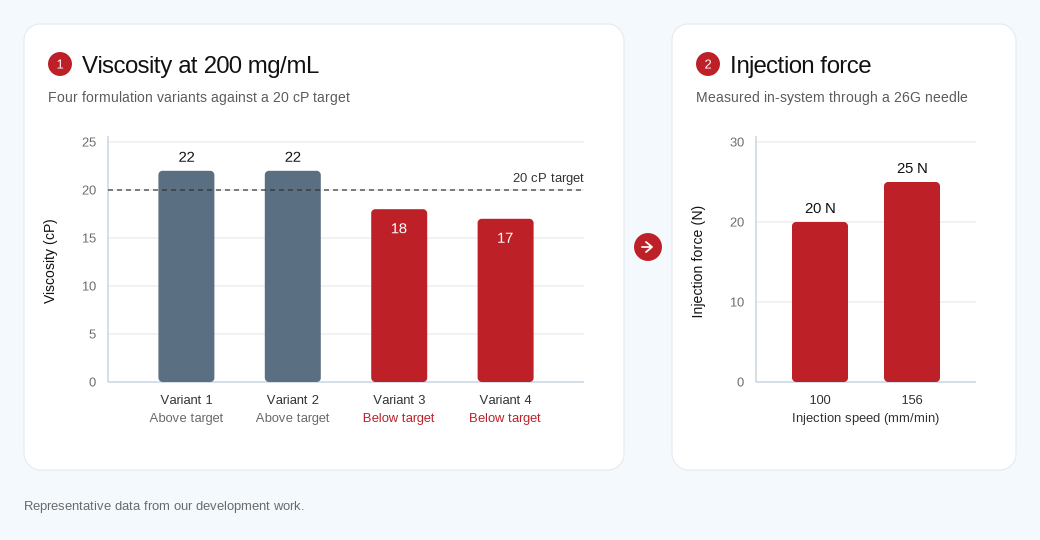
A concentration target matters only if the formulation can be drawn up and injected. Viscosity gives an early estimate, but injection force limits injectability in practice, and the acceptable force depends on your device, needle, and volume.
So, we measure viscosity at target, then syringeability and injection force in-system, in the intended syringe. In a representative program, a mAb went from 110 to 200 mg/mL at under 20 cP, injectable through a 26G needle.
Send us six things. We'll send back a scope.
Under a CDA: your sequence or molecular weight, pI, development stage, and target dose, volume, and device. You get a proposal with what we’d test, in what order, and how long it takes. Programs can start at any stage.
Questions we know you have, and actually helpful answers
How much material do I need for high-concentration feasibility?
Under 200 mg of API per candidate: about 35 mg to screen variants, then about 150 mg to test leads at high concentration. Stability and syringe studies need more material.
How long until we know whether subcutaneous dosing is possible?
Within four weeks of project start for preclinical feasibility: about two weeks of screening, then one to two weeks of concentration challenge. Scope alignment to project start takes two to four weeks.
Should we start high-concentration work before candidate nomination?
Yes, ideally. Early screening shows which candidates reach the target concentration while switching is still inexpensive. See Preformulation Screening & Developability for the early screen.
What viscosity or injection force is acceptable for subcutaneous injection?
It depends on your device, needle gauge, injection volume, and patients, so there is no single limit. Viscosity is an early estimate; we measure injection force in your intended device against your target.
Can you improve a high-concentration formulation already in clinical development?
Yes. We identify the cause, such as viscosity, aggregation, or particles, and adjust excipients or process.
Can you test syringeability and injectability at our needle gauge and speed?
Yes. We assess syringeability and measure injection force in your intended prefilled syringe, cartridge, or dual-chamber system, at the needle gauge and injection speed you plan to use.
When should I consider a lyophilized high-concentration formulation?
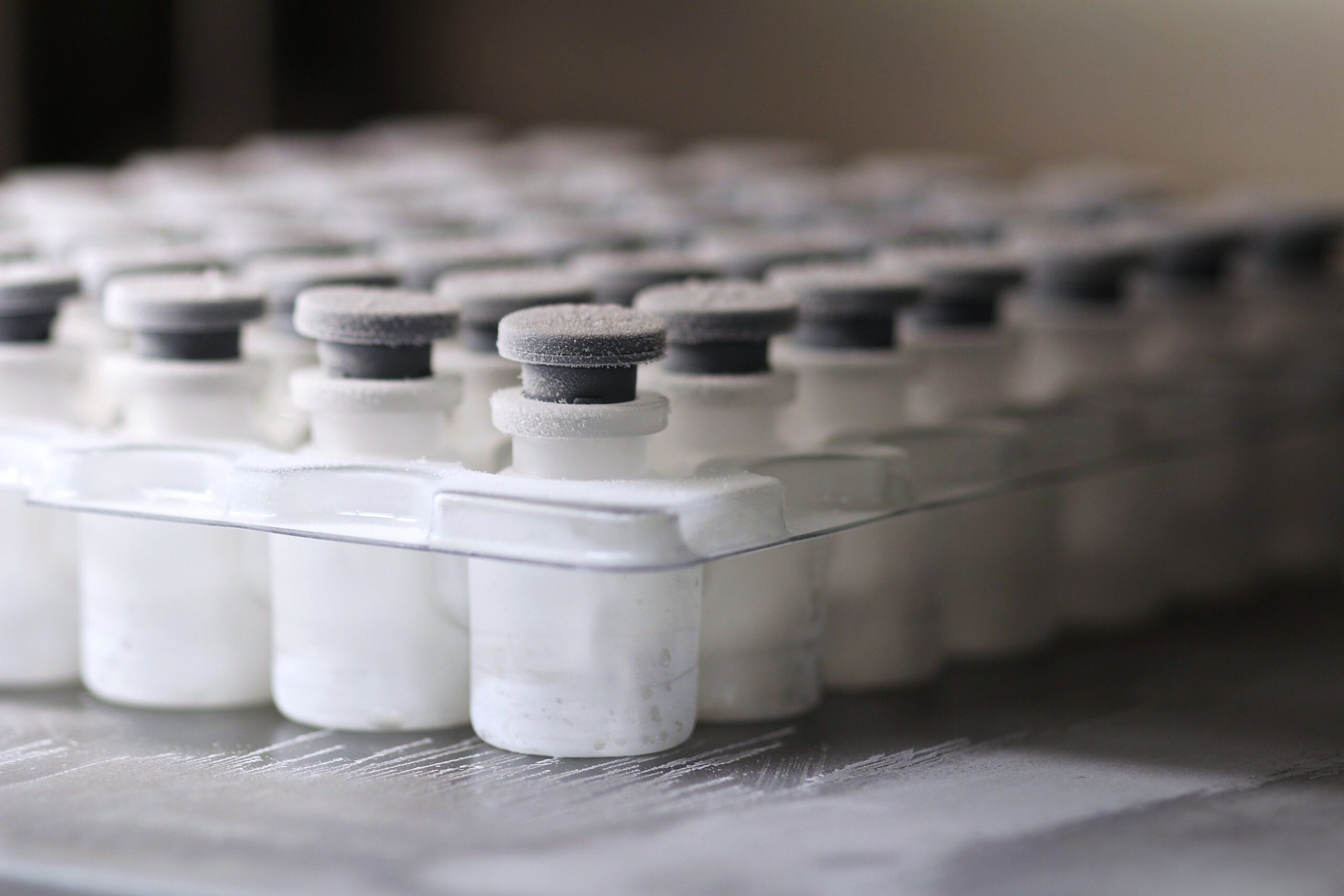
When liquid stability at the target concentration is limited. We develop easy-to-reconstitute high-concentration lyophilizates, together with the freeze-drying process that produces them.
Do you formulate ADCs at high concentration?
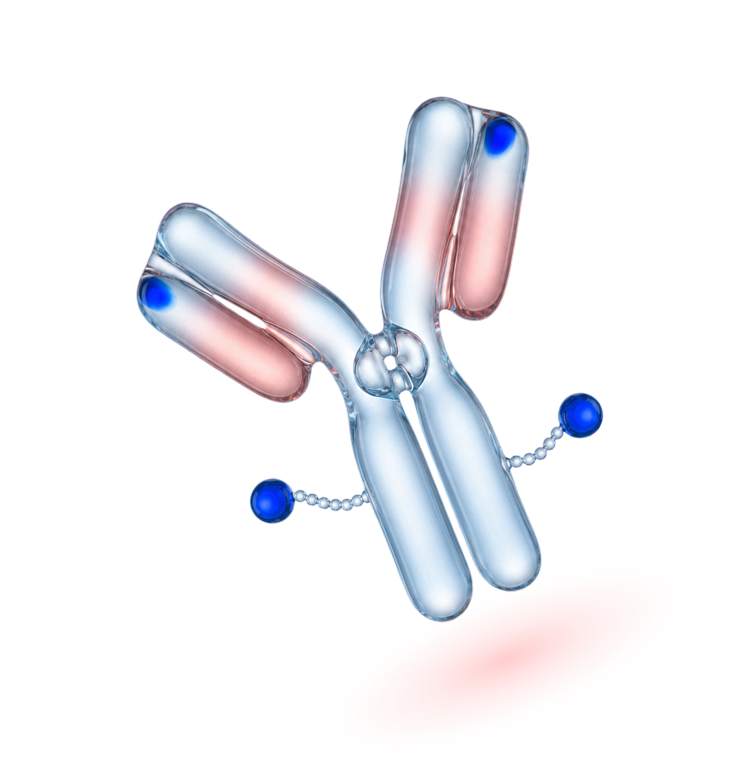
Yes. Six of our 29 ADC programs have been high-concentration or subcutaneous, covering the antibody intermediate and the final ADC drug product. See ADC formulation development.
Didn’t find your question? Conversations and quotes are always free.
Let’s talk about your molecule and what it needs to go subcutaneous.
Our calls get technical quickly. If another partner fits better, we’ll tell you.