
Injectable formulation development. Built to transfer.
We develop liquid and lyophilized formulations for proteins, antibodies, peptides, ADCs, small molecules, and viral and nanoparticle systems.


Since 2010, in numbers
- Of those 178: 98 in clinical trials, 80 market approvals, including generics and biosimilars.
completed formulation, process, and CMC projects
formulations advanced to GMP manufacturing
clients, from start-up to large pharma
from scope alignment to project start
Each molecule degrades in its own way. We formulate around it.
A biologic stays active only while its three-dimensional structure holds through shelf life. Temperature, light, oxygen, freezing, shear, and surface contact can each push it toward unfolding, aggregation, cleavage, or chemical modification. Small molecules have their own limits, mainly solubility and chemical degradation.
Any of these could change potency, purity, or particle counts before the product reaches a patient.
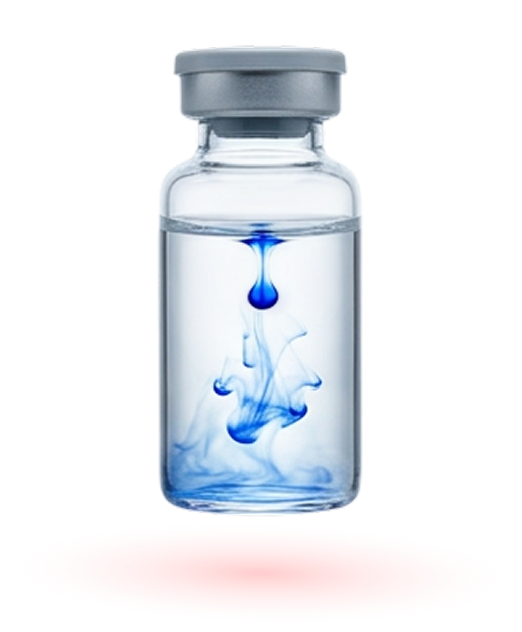
Rational, quality-by-design (QbD) development
We characterize the molecule’s physicochemical state and response to excipients, then use design of experiments to set pH, ionic strength, buffer, detergent, and stabilizers, in line with ICH Q8.
Stability measured, then confirmed
We build the molecule’s stability profile from colloidal and conformational stability, aggregation, sub-visible particles, viscosity, and osmolality, then use forced stress to find its degradation pathways early.
What we screen for under stress:
- Aggregation
- Fragmentation
- Oxidation
- Particle formation
- Freeze-thaw damage
- Surface adsorption
Where is your program now?
Most programs come to us at one of three points. Preclinical work needs a formulation that holds for animal studies. Phase 1 needs one your manufacturer can fill. Late phase and lifecycle work often means a new concentration, route, or container. Your timeline, material, dose, and presentation decide where we start.
Preclinical
Goal: A formulation that keeps the molecule stable through animal studies
Liquid, frozen liquid, or lyophilized when aqueous stability is limited
pH, buffer, excipient, and solubility screening across the dose range
Forced stress, then accelerated stability on the lead formulations
Robustness data; non-GMP batches for toxicology studies if needed
Data that shape the Phase 1 formulation and process
Entering Phase 1
Goal: A formulation your manufacturer can fill for first-in-human supply
Often lyophilized or frozen liquid; liquid where stability allows
DoE optimization of pH, ionic strength, detergents, and stabilizers
Accelerated stability in the clinical primary packaging
Formulation, process description with design space, GLP-like documentation
Transfer to your manufacturer for GMP clinical supply
Late phase and lifecycle
Goal: A commercial presentation backed by a robust, well-understood process
A new presentation, for example lyophilizate to liquid, or the reverse
Higher concentration, a new route, or new primary packaging
Stability profile compared between the current and new presentation
Robustness and design space data in line with ICH Q8
Process transfer and scale-up support for your manufacturer
Three work packages, one formulation
We split formulation development into three work packages, each ending with a go/no-go decision based on data. Screening narrows the options, development sets the composition, and confirmation tests it in the final container.
Formulation screening
- Physicochemical characterization (colloidal and conformational stability)
- pH, buffer, and ionic strength
- Excipient and detergent screening
Formulation development
- DoE-based composition optimization
- Liquid, frozen, or lyophilized formulation
- Amorphous or crystalline matrix design for lyophilizates
- High concentration and viscosity
- Route fit: i.v., s.c., i.m., or other
- Forced stress and degradation pathways
Confirmation and transfer
- Accelerated stability in the final container
- Primary packaging compatibility
- Sterile filtration and manufacturability assessment
- Aseptic, non-GMP preclinical batches
- GLP-like documentation for submission
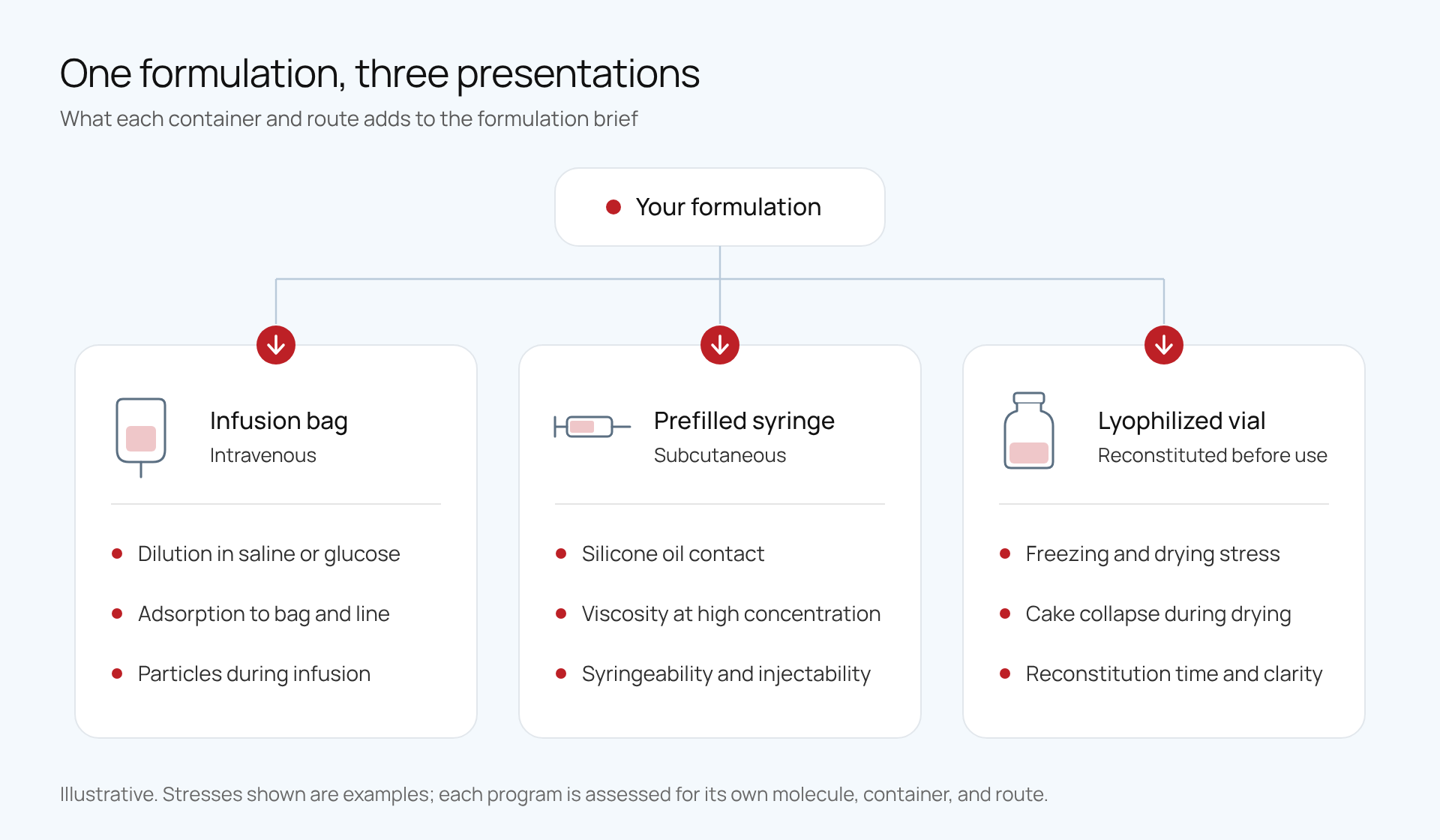
A formulation that works in a vial can still fail in a syringe.
The container and route add stresses that a vial study may not show. Silicone oil in a prefilled syringe, viscosity at high concentration, and dilution in an infusion bag can change aggregation or particle counts. We test the formulation in its intended container and administration setup, and adjust detergent and excipients before stability studies start.
Highlights: a prefilled-syringe formulation above 225 mg/mL that needed detergent and antioxidant to pass light, agitation, and freeze-thaw stress.
Send us your molecule's basics. We'll send a scope.
Under a CDA, send us the molecule type and key properties, any formulation and stability data, your target dose, route, and container, and the material available. You get a proposal: what we would test, in what order, and how long it takes. Average client satisfaction: 9 out of 10.
Frequently asked questions and helpful answers
Which molecules and formats do you formulate for injection?
Recombinant proteins, antibodies of all IgG isotypes (mono- and bispecific), fusion proteins, cytokines, growth factors, peptides, ADCs, cytotoxic and other small molecules, viral therapeutics, VLPs, ATMPs, and sustained-release systems such as liposomes and nanosuspensions.
Can you formulate poorly soluble or highly potent small molecules?
Yes. We run solubility screening and lyophilize from organic solvents or solvent and water mixtures where needed.
Cytotoxic work runs in separate laboratories, up to OEB5 (SafeBridge category 4).
How long does formulation development usually take?
Formulation development typically takes 5 to 8 weeks, depending on the molecule and the work packages.
Projects usually start 2 to 4 weeks after scope alignment, and we report results within 5 days.
Can you make formulation batches for preclinical and toxicology studies?
Yes. We produce aseptic, non-GMP preclinical batches for PK/PD and toxicology studies, usually in vials, with the filter types, pumps, and contact materials planned for manufacturing.
Will the formulation transfer to our manufacturer for GMP production?
Yes. We run sterile filtration studies, fill and finish mock-ups, and manufacturability assessments, then provide technical transfer support for the move to GMP manufacturing.
Liquid, frozen, or lyophilized: how do you choose the presentation?
It depends on the molecule’s aqueous stability, the dose and route, and your timeline.
Liquid is simplest to handle, frozen liquid can shorten the path to first-in-human, and lyophilized suits limited aqueous stability.
Does the route of administration change the formulation?
Yes. Subcutaneous products need syringeability, so the formulation can be drawn up and expelled, and injectability, an acceptable injection force.
Intravenous products need compatibility with saline or glucose diluents, infusion bags, and lines.
Can we book a single work package instead of a full program?
Yes. We take full development programs, feasibility trials, single work packages, or parts of a larger program.
Each project has a dedicated pharmaceutical development manager as your direct contact.
Didn’t find your question? Conversations and quotes are always free.
Let's talk about your molecule and the formulation it needs next.
Our calls veer technical fast. If we’re not the right partner, we’ll say so.